Picture this. Your CBD brand is growing on two fronts at once. Retail shops keep reordering your gummies by the case. At the same time, your website is quietly ringing up tinctures and topicals for shoppers across the country. It feels like one business. So, you run every dollar through a single checkout.
Trouble begins when small online chargebacks start a ripple effect that increases your ratio. This prompts your acquiring bank to increase your reserve. A large wholesale order is then flagged for review. The payment setup that appeared simple is now the biggest obstacle.
Here’s the difficult reality. There’s a significant difference between CBD wholesale and DTC sales. When you run both sales models through a single payment system, you end up getting the worst consequences of both. In this guide, we discuss CBD payment processing with CBD wholesale sales, direct-to-consumer (DTC) sales, the necessity of different payment flows, and the advantages of dividing them.
Why CBD Payment Processing Is Different in the First Place
Before we talk about splitting flows, it helps to remember why CBD is a special case at all.
CBD products can be sold legally almost everywhere in the U.S. with the passing of the 2018 Farm Bill, but banks still consider these products high risk because the laws vary from state to state and the FDA hasn’t made a final decision on CBD in food and supplements. This makes underwriters cautious.
That caution is easy to spot. Stripe, PayPal, and other mainstream payment processing services flat out ban CBD from their platforms. Therefore, a hemp company cannot just enable a default checkout with these services. Instead, these companies have to get a high-risk merchant account from a provider that is willing to offer the MCC 5912.
These accounts have a lot of restrictions. You should expect rates that can vary from 3.5% to 5.5% with interchange-plus pricing, rolling reserves, and a lot of focus on your chargeback ratio compared to the 1% threshold that is standard across the payment processing industry. This is the payment processing environment for CBD companies, and this is why you should avoid using a single account to sell two very different types of products.
Wholesale and DTC Behave Like Two Different Businesses
On paper, both channels sell the same products. At the register, they could not act more differently.
How DTC CBD Sales Behave
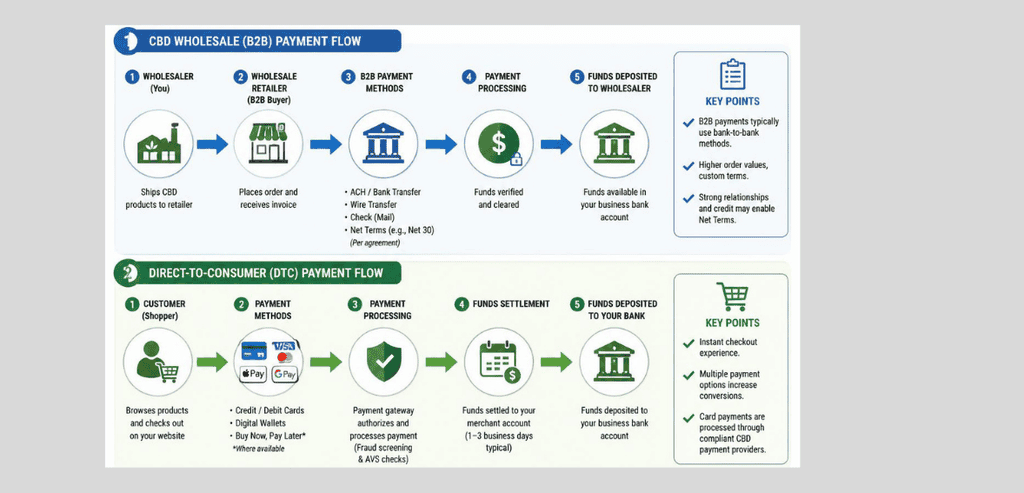
Your direct-to-consumer flow is fast and high in volume. A shopper lands on your site, adds a product, and pays by card on the spot. It is a card-not-present transaction with a small average ticket. One buyer, one price, instant payment.
That speed comes with friction. Card-not-present sales draw more fraud and more disputes. CBD makes this worse. Customers get confused about auto-renewing subscriptions. Shipping delays spark refund requests. “Friendly fraud,” where a real buyer disputes a real purchase, is common. CBD chargebacks tend to run well above standard retail, which is exactly why the DTC side needs tight fraud tools.
How CBD Wholesale Orders Behave
Your wholesale flow goes in the opposite direction. Your orders are considerably larger but far fewer in number. A retailer might purchase several thousand dollars worth of product or several cases.
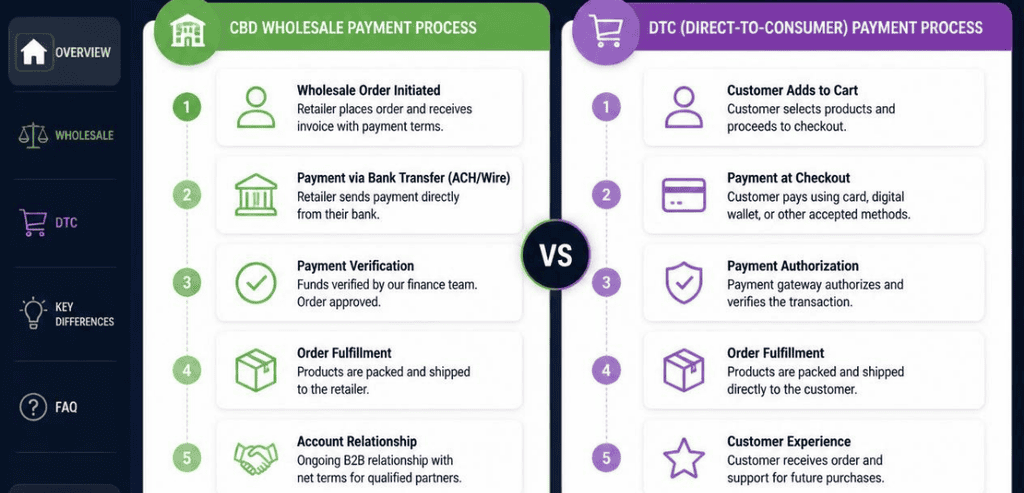
Wholesale buyers expect to pay on terms as opposed to cash transactions. Payment terms end up being the rule, rather than the exception. A retailer will pay for an order 30, 60, or even 90 days after the invoice date. They will also choose to pay via ACH or wire, as opposed to a card, and will submit a purchase order rather than enter a card number online. If a buyer has been purchasing from your company for 3 years on Net 30 terms, and is all of a sudden required to pay via card during an online order, that buyer is likely to order the same products via a phone call.
There is a significant gap here that payment professionals have noted as the most common and costly mistake in B2B. Wholesale orders are not the same as retail orders, and your payment solution should not treat them as such.
The Problem With Running Both Through One Payment Flow
What actually breaks when you try to force both channels into a single merchant account? A few things, and they tend to hit at the worst time.
First, your chargeback math will go haywire. DTC chargebacks are frequent and small. Wholesale chargebacks are infrequent and large. Mix the two, and your chargeback ratio will swing in ways that underwriters will not accept. A very cheap online order can put your account, including safe wholesale volume, under review.
Second, reserves will hurt your best revenue. If the acquirer sees that the retail side has an increased chargeback risk, it may reserve 5% to 10% of your entire sales volume for several months. This will negatively impact your cash flow on large wholesale orders, as it will be levied on your wholesale volume as well.
Finally, the headache of not having a good system of segregation and integration will hit you. DTC payments arrive practically right after you make a sale, while wholesale payments will be slow in coming and divided. This creates an accounting mess, and you will miss payments.
A single flow will force you to optimize for nothing. You will end up with an expensive wholesale order and a DTC order with weak fraud controls.
Signs It Is Time to Split Your Payment Flows
You do not need to separate on day one. Plenty of small brands start with a single account and a simple invoice process. The signals usually arrive as you scale.
Watch for a rising chargeback ratio that traces back mostly to online orders while your wholesale accounts stay clean. Watch for wholesale buyers asking for Net 30 or Net 60 that your current checkout cannot offer. Watch for card fees quietly eating your margin on five-figure B2B deals that would cost far less over ACH. Watch for reserve increases that trap wholesale cash. And watch for the moment your accounting team starts dreading month-end because two very different payment streams live in one messy report. When two or three of these show up together, separate flows stop being optional.
What Separate Payment Flows Actually Look Like
Splitting your flows does not mean running two disconnected businesses. It means routing each channel through the setup built for it, often under distinct merchant IDs on the same gateway.
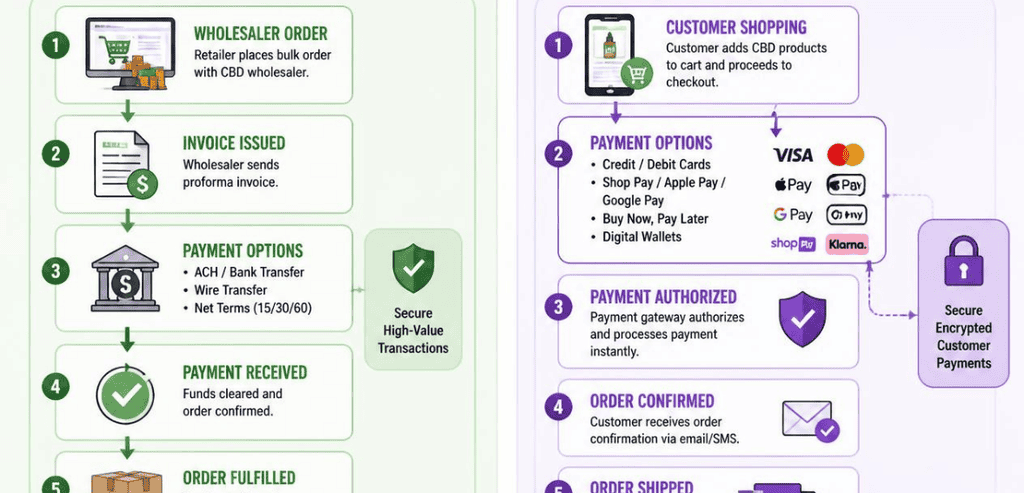
The DTC Flow
Your consumer side needs to be fast and robust against fraud. Maintain the card-not-present checkout for Shopify, WooCommerce, or BigCommerce via a high-risk gateway. Dispute protection can be more aggressive here, and for good reason. Most troublemakers congregate here, after all. Chargeback alerts like Ethoca and Verifi prevent a chargeback from progressing, and if you pair these services with AVS, CVV checking, and 3D Secure, you’ll have a greater than 99% success rate of chargebacks not occurring.
The Wholesale Flow
Your B2B side shouldn’t have a retail cart, but should have credit and invoicing. This is the space CBD wholesale payment processing fills. You can assign a credit limit and clear net terms to each buyer account. Invoicing at the time of order creates a due date, and reminders can be set to notify the account as the due date approaches.
You can lean on ACH for these payments. Payments via ACH have a much lower cost than card payments (often about 1% or less) and carry significantly lower chargeback risk, which makes them ideal for large and repeated orders of B2B wholesale. When wholesale buyers pay via a commercial card, ensure that your processor has Level 2 and Level 3 data support.
Choosing the Right CBD Wholesale Payment Processing Setup
After you decide to split, the provider you choose matters more than almost any other partner. This is most evident when working with a high-risk merchant service specialist.
To begin, inquire about their ability to handle Dual MIDs. The ideal solution allows the separation of the two MIDs for direct-to-consumer (DTC) and wholesale via the same dashboard using smart transaction routing. Be sure to ask about reserves. If a wholesale MID uses a rolling reserve, it can become quite expensive. In addition, press for interchange-plus pricing and avoid tiered pricing. Tiered pricing hides the real costs you are incurring. Make sure the merchant service provider has a gateway that integrates with your storefront and your accounting/ERP system. This will ensure your invoices and settlements are reconciled and saved.
In the end, choose the highest level of service available at the best price. In CBD, saving a few basis points only to face account closures results in a loss. This is especially true if your account is unmanaged and gone shortly after being opened, versus the account of a highly experienced, pricier hemp underwriter. The USDA’s hemp program guidance helps when you begin to pull together the requested compliance documents from serious processors.
Conclusion
CBD brands rarely outgrow a single payment flow all at once. It happens quietly, order by order, until the setup that once felt easy starts costing you money and sleep. Wholesale and DTC pull in opposite directions. One wants speed, small tickets, and airtight fraud control. The other wants credit, net terms, and low-cost ACH on large invoices.
Separating the two lets each channel do what it does best. Your DTC checkout stays fast and defended. Your wholesale flow keeps buyers happy with the terms they expect while protecting your margin and cash flow. Treat the split as a growth milestone, not a burden. When your CBD wholesale payment processing and your consumer checkout each run on the right rails, both channels can scale without dragging the other down.
Frequently Asked Questions
Do I really need two merchant accounts for CBD wholesale and DTC?
Not always, but it becomes wise as you grow. Many CBD brands run separate MIDs on one gateway so their high-volume online disputes do not endanger their large, low-risk wholesale deposits. If your channels behave very differently, splitting protects both.
Why is ACH better than credit cards for CBD wholesale payments?
ACH bank transfers cost far less than card processing, often near 1%, and they carry much lower chargeback risk. For large, repeat B2B orders, that combination saves real money and reduces the dispute exposure that threatens high-risk accounts.
Can I use Stripe or PayPal for CBD payment processing?
No. These aggregators prohibit CBD in their acceptable-use policies and will freeze or close accounts that sell it. CBD brands need a dedicated high-risk merchant account through an acquiring bank that underwrites hemp products.
What is a rolling reserve, and will it affect my wholesale cash flow?
A rolling reserve is a percentage of your processing volume the acquirer holds temporarily to cover potential disputes. If wholesale runs through the same account as risky DTC sales, that reserve can trap your large B2B deposits. Separating flows helps keep clean wholesale revenue liquid.